The moment a US company hires its first engineers in Bengaluru or Pune through its own entity, it acquires two compliance lives: one in India, one at home. Most founders prepare carefully for the Indian side and discover the American side a year later, when their US tax preparer asks a question nobody warned them about: "Does your company own a foreign corporation?"
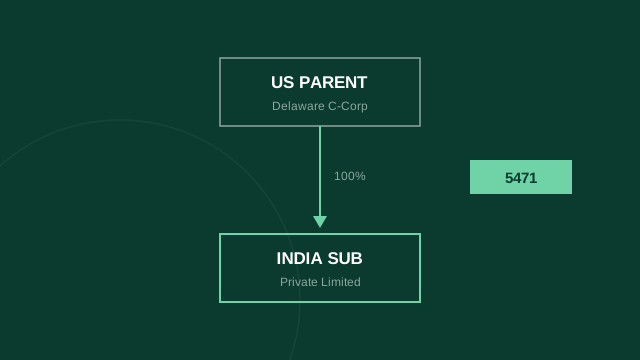
The structure, in one picture
The Indian vehicle is almost always a Private Limited Company. It needs at least two shareholders (the US parent plus a nominee for the second share is the common pattern), at least two directors with one resident in India, and registration through India's incorporation process. Once running, it lives on the Indian compliance calendar: corporate income tax, statutory audit, registrar filings, payroll withholding, and GST where applicable. Any competent Indian CA will keep that side moving.
What the US side requires
Form 5471. A US company that controls a foreign corporation files an information return about it every year, attached to the parent's own return. It is detailed: balance sheet, income statement, transactions with the parent, earnings history. The penalty for not filing starts at $10,000 per form, per year, and it applies whether or not the subsidiary sent a single rupee home. If the subsidiary exists, the form is due.
Transfer pricing. Every invoice between parent and subsidiary must reflect an arm's-length price, and both countries police it. India requires transfer pricing documentation and, for the common captive development center, expects the subsidiary to earn a real margin on its costs. The US applies its own arm's-length rules to the same transactions. The practical foundation is one well-drafted intercompany services agreement with a defensible cost-plus margin, priced before the first invoice, not reconstructed at audit.
The anti-deferral rules. Since 2017, US parents cannot simply leave profits parked abroad untaxed. A US parent may owe US tax on a portion of its subsidiary's earnings even before any dividend is paid. For a services subsidiary that earns a modest cost-plus margin, the effect is often manageable, but it belongs in the plan from the start, not as a surprise at filing time.
Foreign account reporting. The subsidiary's Indian bank accounts can fall within the US parent's FBAR reporting where ownership and authority thresholds are met. It is a checkbox-simple filing with a painful penalty for silence.
The mistakes we clean up most often
No intercompany agreement. The parent wires money monthly; the subsidiary spends it. Without a services agreement and a pricing basis, both tax authorities are free to characterize those flows however suits them.
Skipping Form 5471 because "there were no dividends." The form reports existence and activity, not just distributions. This misunderstanding is the single most common source of the $10,000 penalty in this corridor.
Two advisers, no bridge. An Indian CA who has never heard of Form 5471, and a US CPA who has never seen an Indian statutory audit. Each side is compliant in isolation; the structure as a whole is not.
The durable fix is structural
Run both sides on one calendar, with one team accountable for the whole picture. The Indian filings feed the US filings; the transfer pricing position is set once and applied consistently; and the board sees one consolidated view instead of two disconnected ones. That is the entire design of our Global Expansion service.
This article is general information about US and Indian rules as they commonly apply, not tax or legal advice for your situation. Rules, thresholds, and penalties change; how they apply depends on facts we haven't seen. Speak with a qualified adviser before acting.