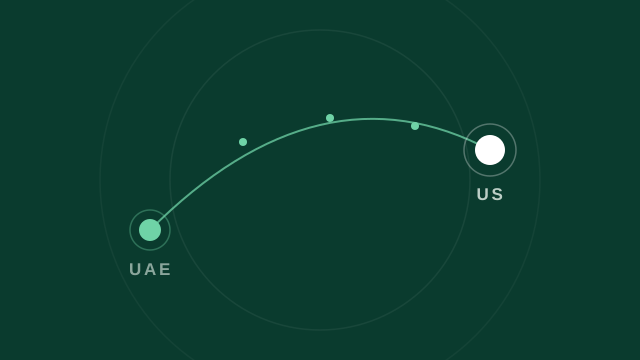
Every month, businesses across Dubai, Abu Dhabi, and the wider Gulf set up US companies. The formation itself takes days and costs little. What separates the ones that run smoothly from the ones that collect penalty notices is everything that happens after the certificate arrives.
Why UAE businesses come to the US
The reasons are consistent. American customers prefer contracting with an American entity. US payment infrastructure, from Stripe to major acquiring banks, works best with a US company and a US bank account. US investors, if a raise is in your future, fund US entities almost exclusively. And a Delaware company on the letterhead carries weight in procurement processes worldwide.
None of that requires relocating. A UAE parent company can own a US subsidiary outright, and the whole structure can be run from the Gulf. The shape is simple:
LLC or C-Corp: the first real decision
Most formation services default you into a single-member LLC because it is the cheapest thing to sell. Sometimes that is right. Often it is not.
An LLC owned by your UAE company is a "disregarded entity" for US tax purposes. Profits flow through to the owner, and in many service businesses with no US office or staff, US federal income tax on those profits can be limited. The trade-offs: the foreign-owned LLC still files Form 5472 with a pro forma Form 1120 every year, banks scrutinize it harder, and US investors will not fund it.
A C-Corp pays US corporate tax on its profits, files a full Form 1120, and adds a layer of formality: board minutes, share issuance, and clean separation from the parent. In exchange, it is the structure every US investor, major customer, and acquirer understands. If a raise or a large enterprise contract is anywhere in your plans, the C-Corp usually earns its keep.
The honest answer is that this decision depends on what the US entity will actually do: invoice customers, hold inventory, employ people, or raise capital. Deciding it on the formation service's checkout page is how restructuring projects are born.
Delaware, Wyoming, or somewhere else
Delaware remains the default for a reason: the most developed corporate law, the fastest filings, and universal recognition by banks and investors. Its cost is the annual franchise tax and a registered agent fee. Wyoming is cheaper and privacy-friendly, and can suit holding structures and simple LLCs. And if your US entity will have a physical presence, employees, or significant sales in a specific state, you will register there anyway, so the "home" state choice matters less than the brochures suggest.
The EIN, without an SSN
Every US company needs an Employer Identification Number before it can open a bank account, run payroll, or file anything. A persistent myth says you need a Social Security Number or an ITIN to get one. You do not.
A foreign owner obtains an EIN by filing Form SS-4 with the IRS by fax or mail, listing themselves as the responsible party with "Foreign" in place of an SSN. Processed by fax, it typically takes a few weeks. The details matter: a mismatch between the SS-4, the formation documents, and the later tax filings creates problems that surface months later, usually at the bank. The full sequence is in our EIN briefing.
The filings that follow
This is the part nobody mentions at formation, and the reason we wrote a separate briefing on Form 5472. In summary, a UAE-owned US company files every year, whether or not it made money:
- Form 5472 with a pro forma 1120 (foreign-owned LLC) or a full Form 1120 (C-Corp). The 5472 penalty is $25,000, automatic, and assessed against dormant companies too.
- Delaware franchise tax and annual report, on its own calendar, with penalties and loss of good standing if missed.
- State registrations where you actually operate: sales tax if you sell into states with nexus, payroll registrations if you hire.
- Withholding and W-8BEN-E paperwork on payments crossing the border. The default US withholding on many payments to a foreign person is 30%; treaty positions and correct documentation are how that number comes down.
The mistakes we clean up most often
"No income means no filing." False for Form 5472, false for franchise tax, and the most expensive myth in this corridor. Funding your own company's bank account is a reportable transaction.
Mixing personal and company money. Wires from personal accounts, expenses paid from the parent without documentation, no inter-company agreement. Every one of these becomes a reportable transaction to reconstruct years later.
Formation without a calendar. The registered agent files nothing for you. The formation service's job ended at the certificate. Unless someone owns the compliance calendar, nobody does.
The durable fix is structural
None of this is difficult. It is merely invisible from Dubai until a notice arrives. The fix is the same one we apply to every engagement: decide the structure deliberately before the first invoice, put every obligation of every entity on one calendar with an owner and a due date, and have one team accountable on both sides of the border.
This article is general information about US rules as they commonly apply, not tax or legal advice for your situation. Rules, thresholds, and penalties change; how they apply depends on facts we haven't seen. Speak with a qualified adviser before acting.