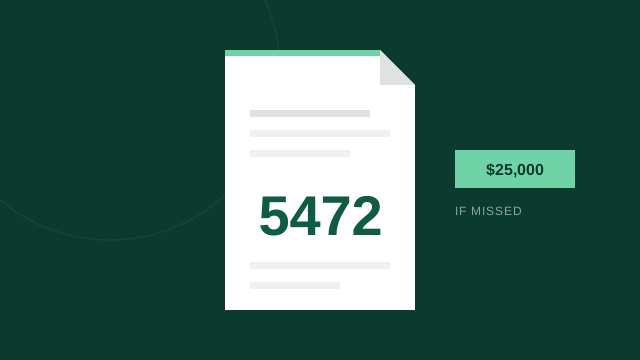
A single-member Delaware LLC owned by someone outside the United States looks like the simplest structure in the world. One owner, no US tax return in most years, no corporate formalities to speak of. Then, somewhere in year two or three, the founder learns about Form 5472, usually from a penalty notice.
This article explains what the rule actually is, why it catches so many careful people, and what to do if you have already missed a year. None of it is cause for panic. All of it is cause for a calendar.
The rule, in plain terms
For US tax purposes, a single-member LLC is normally a "disregarded entity": the IRS looks straight through it to the owner. When the owner is a US person, that usually means genuine simplicity: the LLC's activity just lands on the owner's own return.
When the owner is foreign, the simplicity is an illusion. Since the 2017 tax year, a US disregarded entity that is wholly owned, directly or indirectly, by one foreign person has been treated as a corporation for one narrow purpose: information reporting under section 6038A. In practice, that means the LLC must file two things each year:
- A pro forma Form 1120: a cover page of the corporate return, with the LLC's name, EIN, and a notation that it is a foreign-owned disregarded entity. No tax is computed on it.
- Form 5472: an information return disclosing "reportable transactions" between the LLC and its foreign owner or other related parties.
The phrase "reportable transactions" is where founders get caught. It does not mean revenue. It includes the money you put into the LLC and the money you take out. Capital contributions, distributions, loans to or from the owner, payments the owner makes on the LLC's behalf, and even the amount you paid to form the company can all be reportable transactions. An LLC that earned nothing, sold nothing, and sat dormant all year very often still has a Form 5472 obligation, because funding a bank account is a transaction with a related party.
Why the mistake is so common
Three reasons, and none of them is carelessness.
First, the filing runs against intuition. Every founder learns early that a disregarded entity "doesn't file its own return." That is true for income tax and false for this information return, and the exception is not printed anywhere on the formation paperwork.
Second, nobody in the formation pipeline mentions it. Registered agents and online formation services deliver a certificate, an EIN, and congratulations. Their job ends where the compliance calendar begins. The founder reasonably assumes that if something were due, someone would have said so.
Third, the filing itself is awkward. A pro forma 1120 with an attached 5472 generally cannot be e-filed through consumer software; it is filed by mail or fax to a dedicated IRS unit. Even people who learn about the obligation sometimes fail to land it correctly.
What missing it costs
The penalty for failing to file Form 5472, or filing it substantially incomplete, is $25,000 per form, per year. It applies per related party, so an LLC with reportable transactions involving two related parties can face two penalties for a single year. If the failure continues after the IRS issues a notice, an additional $25,000 accrues for each 30-day period of continued non-compliance.
Two things are worth saying calmly. The penalty is real and is assessed in practice, including against dormant companies. And it is frequently abated: the law provides relief where the failure is due to reasonable cause and not willful neglect, and a well-documented reasonable-cause statement, filed with the late returns before matters escalate, succeeds often enough that a missed year should be treated as a problem to be managed, not a catastrophe.
The mechanics, so nothing is left vague
- Who files: any US disregarded entity (typically a single-member LLC) wholly owned by a foreign person, and any 25%-foreign-owned US corporation with reportable transactions.
- What triggers it: any reportable transaction with a foreign related party during the year, including contributions, distributions, loans, payments of expenses, and formation and dissolution amounts for disregarded entities.
- What you need first: an EIN. The responsible-party disclosures on the EIN application are also how the IRS knows your LLC exists. Silence is not an available strategy.
- When it's due: with the pro forma 1120, generally April 15 for a calendar-year entity, extendable to October 15 by filing Form 7004.
- How it's filed: by mail or fax to the IRS's dedicated processing unit, not through the standard e-file channels most preparers use by default.
- Recordkeeping: section 6038A also imposes a duty to keep records sufficient to establish the treatment of related-party transactions. A clean ledger is part of the obligation, not an optional extra.
If you have already missed a year
Move deliberately, not frantically. The sequence that works is: reconstruct the LLC's related-party transactions from bank records; prepare the late pro forma 1120 and Form 5472 for each open year; attach a reasonable-cause statement that tells the truth plainly (who you relied on, what you were told, when you discovered the obligation, and what you have done since to make the failure impossible to repeat); and file before the IRS writes to you, because relief is materially easier to obtain when the correction is voluntary.
What you should not do is skip the missed years and quietly start filing "from now on." Partial compliance creates a visible gap and forfeits the credibility that makes reasonable-cause relief work.
The durable fix is structural
Form 5472 is not difficult. It is merely invisible, annual, and unforgiving, which makes it a perfect example of why cross-border compliance fails: not through hard problems, but through unseen ones. The durable fix is not remembering harder. It is a system in which every obligation of every entity sits on one calendar, with an owner, a due date, and a completed-or-not status that someone is paid to watch.
That is how we run it for clients. The LLC files on time not because anyone remembered, but because nothing at Mizenna depends on remembering.
This article is general information about US tax rules as they commonly apply, not tax or legal advice for your situation. Rules, thresholds, and penalties change; how they apply depends on facts we haven't seen. Speak with a qualified adviser before acting.